Licensed amateur radio operators in the USA are permitted by the FCC to transmit analog or digital live, fast-scan, color television pictures with audio. These transmissions are allowed in the 70 cm (420–450 MHz) band and all higher amateur radio bands.
Analog vs. Digital Television
When commercial TV broadcasting transitioned from analog to digital, the standard 6 MHz channel widths and spacings were retained. (Broadcast TV channel widths vary around the world, but the USA uses 6 MHz.) Regardless of mode, all emitted spectrum — analog or digital — must remain contained within the FCC-authorized 6 MHz channel.
Analog TV uses Vestigial Upper Sideband (VUSB) modulation for the video signal, with the video carrier located 1.25 MHz above the lower channel edge. The audio uses FM modulation with 25 kHz deviation, placed 4.5 MHz above the video carrier (5.75 MHz above the lower channel edge). Transmitter power is measured as peak-envelope power (PEP), with the peak occurring on sync tips.
Digital TV (DATV) channels are identified by their center frequency rather than an offset. Commercial broadcast digital TV uses 8VSB-ATSC modulation to convey both video and audio. Cable TV systems typically use Quadrature Amplitude Modulation (64–256 QAM).
Many TV amateurs are transitioning to digital TV. The most common modulation standards are DVB-T (Digital Video Broadcast – Terrestrial) and DVB-S (Digital Video Broadcast – Satellite), with maximum bandwidths of 6 MHz. To preserve spectrum and allow for closer signal spacing, some DATV repeater groups — including ATCO — use narrower DVB-T bandwidths down to 2 MHz.
Band-by-Band Guide
70 cm Band (420–450 MHz)
The most popular band for ATV by far, primarily using commercial broadcast and cable TV channels 57 to 61.
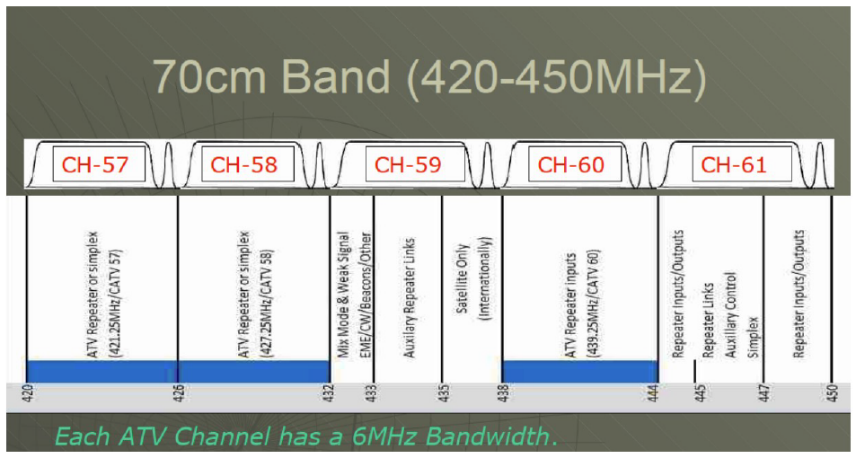
- Capacity: 30 MHz of available spectrum; accommodates up to five 6 MHz TV channels.
- Standard Channels: Cable TV channels 57–61 span the 70 cm band. Many hams use these exact frequencies, enabling analog NTSC reception on off-the-shelf TV receivers. DATV users mostly choose DVB-T on this band.
- Non-Standard Frequencies: Some areas established non-standard frequencies years ago, most commonly 426.25 MHz and 434 MHz for AM/VUSB or inverted sideband (VLSB), often requiring specialized down-converters and receivers.
- ARRL Recommendations (see the full band plan at
arrl.org/band-plan):
- Repeater output: Channel 57 (420–426 MHz)
- Simplex: Channel 58 (426–432 MHz)
- Repeater input: Channel 60 (438–444 MHz)
- Frequencies to Avoid:
- Channel 61 (444–450 MHz) — should be completely avoided due to heavy usage by FM voice repeaters.
- Channel 59 (432–438 MHz) — used by some ARES groups for intermittent TV; normally a last resort to protect weak-signal SSB/CW and ham satellites.
33 cm Band (902–928 MHz)
- Capacity: 26 MHz; up to four 6 MHz TV channels. Three CATV channels fit completely within the band.
- ARRL Recommendations: 909–915 MHz, 915–921 MHz, and 921–927 MHz.
- Usage Warning: This is also an unlicensed ISM (Industrial, Scientific, and Medical) band. Operations are subject to severe RFI from ISM users and devices. Due to the high background noise, the 33 cm band is typically avoided for ATV use.
23 cm Band (1240–1300 MHz)
The second most popular band for ATV after 70 cm.
- Capacity: 60 MHz; up to ten 6 MHz TV channels.
- Equipment: Cable channel designators do not extend above 1 GHz, but the L-band IF frequencies of broadcast TV satellites straddle this band. Hams frequently use satellite TV receivers for DVB-S DATV.
- Analog: Either wide AM-TV (up to 20 MHz wide) or FM-TV (typically 4 MHz deviation and 6 MHz sound sub-carriers).
- Digital: 6 MHz bandwidth DVB-T or DVB-S is common using standard analog channels. In Europe, most DATV activity on this band uses narrower-band DVB-S modulation and low-cost satellite FTA receivers.
- ARRL Recommendations:
- TV Channels: 23-1 (1240–1246 MHz), 23-2 (1252–1258 MHz), and 23-3 (1276–1282 MHz).
- FM-ATV: 1240–1260 MHz.
- Most commonly used frequency: 1255 MHz.
- Usage Warnings: FAA radars may limit amateur use in the vicinity of major metro areas. The GLONASS and Galileo satellite systems (1281–1288 MHz) also use this band.
13 cm Band (2300–2310 MHz & 2390–2450 MHz)
- Preferred Region: The cleanest zone for RFI-free TV operation is the 10 MHz segment from 2390 to 2400 MHz — away from Wi-Fi interference.
- Usage Warnings: The ARRL discourages wide-band ATV signals in the lower 2300–2310 MHz portion and prefers all broadband modes to use 2410–2450 MHz. However, 2400–2450 MHz is also an ISM band heavily shared with Wi-Fi routers, leading to severe RFI.
- Special Note: The International Space Station (ISS) uses 2395 MHz for ham school contacts. Ensure you are not interfering with ISS operations.
9 cm Band (3.30–3.45 GHz)
- ARRL Recommendations: Wide-band modes (> 1 MHz), such as TV, are encouraged in the 20 MHz segment of 3.31 to 3.33 GHz. TV is specifically encouraged to use 3.36 to 3.38 GHz. Three 6 MHz TV channels, or one wide-band FM-TV channel, fit in this segment.
5 cm Band (5.650–5.925 GHz)
- ARRL Recommendations: Wide-band modes (> 1 MHz) are encouraged in two 75 MHz segments: 5.675–5.750 GHz and 5.850–5.925 GHz. No specific slots are assigned strictly for ATV.
- Usage Warnings: This band is shared with unlicensed ISM transmitters (5.725–5.875 GHz) and is heavily used for 5.8 GHz Wi-Fi. To avoid interference, place TV operations in the lower (5.675–5.725 GHz) and upper (5.875–5.925 GHz) edges of the band.
- Equipment Note: Inexpensive analog FM-TV transmitters intended for the drone market are presently the most affordable way to do analog ATV at 5 cm. They usually come pre-programmed with 40 channels; some channels fall into the safer 5.675–5.725 and 5.875–5.925 GHz slots.
3 cm Band (10.0–10.5 GHz)
- ARRL Recommendations: Wide-band modes (> 1 MHz), including ATV, are encouraged in two segments: 10.125–10.200 GHz and 10.375–10.450 GHz. The ARRL has not specified specific channel slots for ATV within these segments.
Source credit: Jim Andrews, KH6HTV (www.kh6htv.com), Art Towslee, WA8RMC, and Gemini AI.